
If you’re a Miami homeowner, you already know the frustration: you leave for the weekend, come back Monday, and your pool has turned a disturbing shade of green seemingly overnight. You’re not imagining the pool turning green. Miami is one of the most common and frequently recurring service complaints in South Florida, and the reasons it happens here faster than almost anywhere else in the country are rooted in climate, chemistry, and biology.
This guide explains exactly why pool turning green Miami happens so aggressively, how to fix a green pool safely and efficiently, and most importantly, how to stop it from coming back.
Algae is a photosynthetic organism that needs three things to thrive: sunlight, warmth, and nutrients. Miami delivers all three in abundance, year-round.
Key Insight: A pool that’s “clean enough” in Cleveland will turn green in Miami within 48 hours, even with the same maintenance schedule. Miami pools require a fundamentally different – and more proactive – maintenance approach.
The phrase “the pool turned green” is almost always a symptom, not the root cause. Proper pool chemical balance in Miami requires maintaining multiple parameters simultaneously. When any one of them drifts out of range, the others are affected, and algae exploits every gap.
Here are the parameters that matter most in South Florida conditions:
| Parameter | Ideal Range | Miami Reality | Impact if Off |
|---|---|---|---|
| Free Chlorine | 2.0 – 4.0 ppm | Drops rapidly in UV | Algae growth within 24–48 hrs |
| pH | 7.4 – 7.6 | Tends to drift high | Chlorine loses up to 90% efficacy |
| Total Alkalinity | 80 – 120 ppm | Variable | Unstable pH, scale or corrosion |
| Cyanuric Acid (CYA) | 30 – 50 ppm | Often too high from tabs | Chlorine lock; algae resistant |
| Phosphates | < 200 ppb | High from rain/runoff | Direct algae food source |
Of these, cyanuric acid (CYA) deserves special attention for Miami pools. Most pool owners use stabilized chlorine tablets (trichlor), which contain CYA. Over time, particularly when pools are topped up to compensate for Miami’s evaporation rates, CYA accumulates. When CYA exceeds 80 ppm, it binds to chlorine so aggressively that the chlorine becomes largely ineffective. This is called “chlorine lock,” and it’s one of the primary reasons Miami pools turn green even when chlorine test strips show adequate levels.
WARNING: If your CYA level exceeds 80 ppm and your pool keeps turning green despite regular chlorination, the only reliable solution is a partial or full drain and refill. Dilution is the only practical way to lower CYA.
Not all algae behave the same way, and identifying what you’re dealing with affects the treatment approach:
▌ Green Algae (Chlorophyta)
The most common variety is the cause of the classic green pool. Green algae float in suspension (turning water green) or cling to walls and floors. It responds well to shock treatment and brushing when caught early. Green algae species dominate algae in the pool Miami cases.
▌ Yellow / Mustard Algae
Appears as a yellow or sand-colored film, typically on shaded walls and in corners. Highly chlorine-resistant standard shock rarely eliminates it fully. Requires a dedicated algaecide specifically formulated for mustard algae, plus aggressive brushing.
▌ Black Algae
The most difficult variety to eliminate. Black algae forms protective layers and deep root structures that penetrate porous plaster surfaces. It requires physical scrubbing with a steel brush, concentrated chlorine application directly to the spots, and often repeated treatments over several weeks.
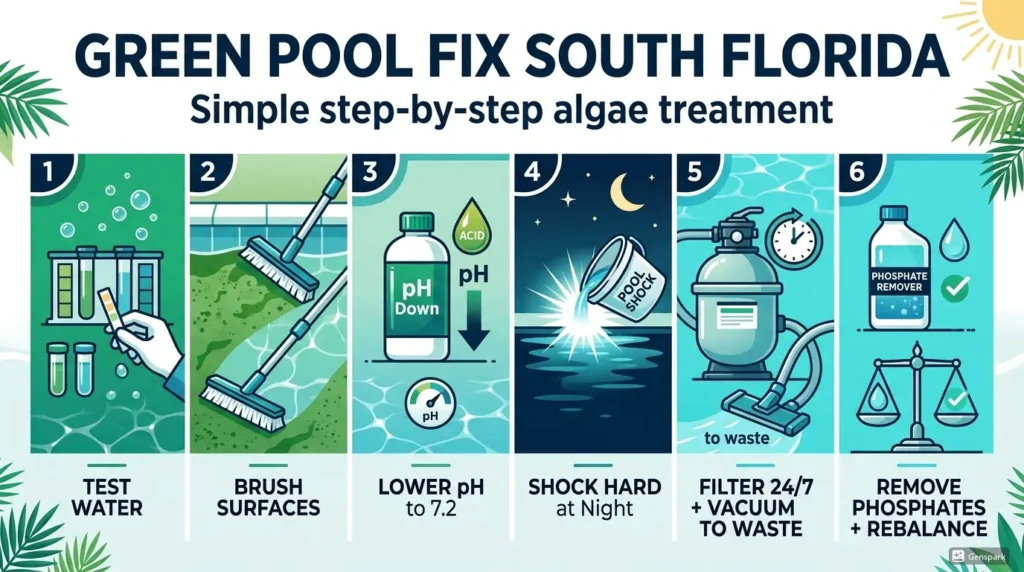
For most cases of algae in the pool in Miami, the following protocol will restore water clarity. Severity will determine how many cycles are needed.
Step 1:Test your water completely. Before adding any chemicals, get a full water chemistry reading — not just chlorine and pH. Test CYA, phosphates, total alkalinity, calcium hardness, and total dissolved solids (TDS). Understanding the full picture prevents wasted product and failed treatments.
Step 2: Brush every surface aggressively. Algae clings to walls, floors, steps, and crevices. Brushing breaks up colonies and exposes them to chemical treatment. Use a nylon brush for fiberglass and vinyl; a stainless steel brush for plaster and concrete surfaces.
Step 3: Balance pH to 7.2. Before shocking, lower your pH to the slightly acidic end of the acceptable range. Chlorine is significantly more effective as a sanitizer at pH 7.2 than at 7.6 or higher.
Step 4: Shock the pool — hard. For a green pool fix South Florida conditions require a heavy chlorine shock: typically 2–4 lbs of calcium hypochlorite (cal-hypo, unstabilized) per 10,000 gallons, depending on severity. Do not use trichlor tabs for shocking — they add more CYA to an already stressed system. Shock after sundown to minimize UV degradation.
Step 5: Run the filter continuously. Keep your pump running 24 hours per day during treatment. A sand filter will need backwashing every 12–24 hours as dead algae loads the media. Consider adding a clarifier or flocculent to help dead algae clump and settle for vacuuming.
Step 6: Vacuum to waste, not to filter. Once the water begins to clear (typically 24–72 hours after shocking), vacuum the pool directly to waste to remove dead algae from the system without passing it through your filter again.
Step 7: Add a phosphate remover. Once the pool is clear, treat phosphate levels with a phosphate remover product. This eliminates one of algae’s primary food sources and significantly reduces the recurrence rate.
Step 8: Re-test and balance. Confirm that all parameters are within the target range before resuming normal maintenance schedules.
Pro Tip: For recurring green pool problems, switch from trichlor tablets to liquid chlorine (sodium hypochlorite) or cal-hypo for regular sanitization. This stops CYA accumulation and gives you full control over chlorine dosing.
Here’s an honest breakdown of what a green pool fix in South Florida costs, depending on whether you DIY or call a professional:
| Green Pool Severity | DIY Treatment Cost | Professional Service Cost | Turnaround Time |
|---|---|---|---|
| Light Green (early-stage algae) | $30 – $60 | $150 – $250 | 24 – 48 hours |
| Moderate Green (murky water) | $60 – $120 | $250 – $450 | 2 – 4 days |
| Dark Green / Blackout Pool | $120 – $200+ | $450 – $800+ | 5 – 10 days |
| Recurring Green (root cause unresolved) | Ongoing | $150–$300/visit | Ongoing |
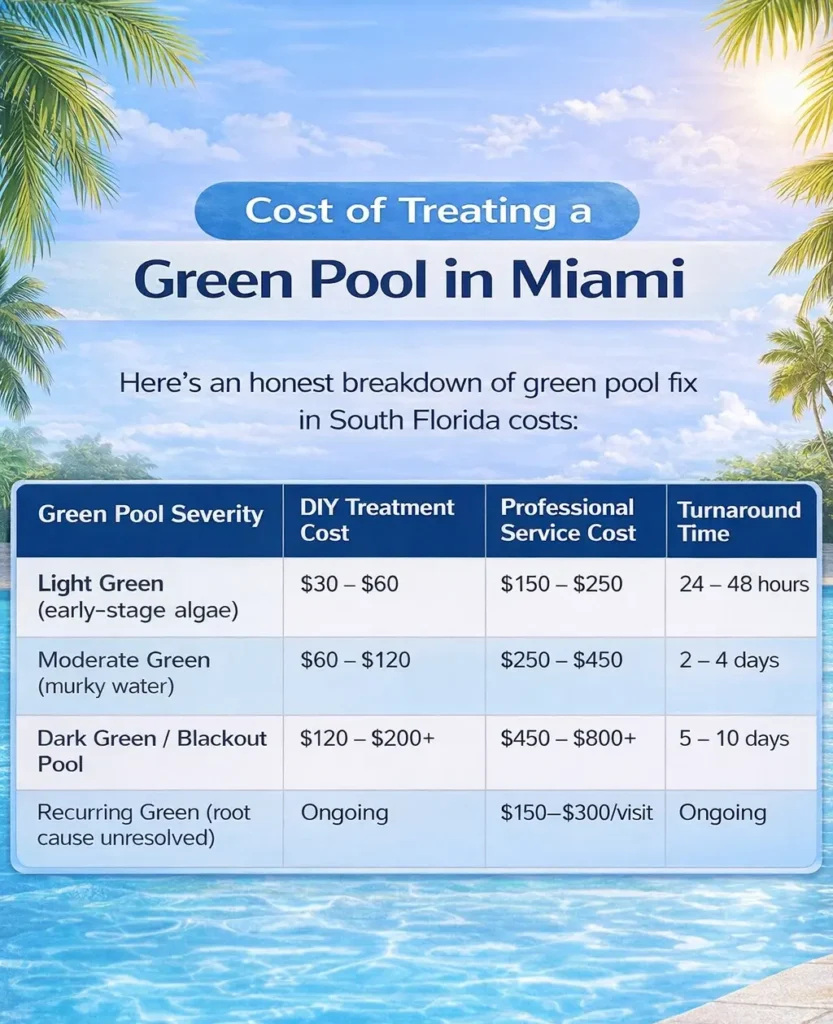
For a dark green or blackout pool, professional service is almost always the smarter investment. Attempting a DIY recovery without proper equipment and a full water chemistry test often results in partial clearing, followed by a rapid return to green, wasting both time and product.
Prevention in Miami requires a higher maintenance standard than most pool care guides suggest. Here’s what actually works in South Florida conditions:
DIY pool care has its limits, and knowing when to call a professional can save you time and effort. If your pool turns completely opaque, stays green despite multiple treatments, or shows no improvement after shocking, it’s time for expert help. Equipment issues like faulty pumps or filters, and high CYA levels above 80 ppm, also require professional handling. In such cases, trusting Reef Tropical Pools ensures your pool is treated correctly, safely, and restored to clean, clear water without further complications.
A properly maintained Miami pool – with correct chemistry, adequate filtration runtime, and proactive phosphate management – should never turn green. If it keeps happening, something in the system needs to change, not just the chemicals.
In Miami’s climate, a green pool isn’t bad luck-it’s a predictable result of heat, sunlight, and unstable chemistry. Fast chlorine loss, high CYA, and phosphate buildup create the perfect environment for algae to thrive. The solution isn’t just shocking the pool but fixing the underlying imbalance and adopting a proactive maintenance routine. With proper chemical control, consistent filtration, and Miami-specific care, you can prevent algae completely and keep your pool clear, safe, and swim-ready all year round.
1. Why does my pool turn green so fast in Miami?
Miami’s intense sun, high temperatures, and frequent rain rapidly reduce chlorine levels and introduce nutrients like phosphates, creating ideal conditions for algae growth within 24–48 hours.
2. Why is my pool still green after shocking?
This usually happens due to high cyanuric acid (CYA), poor filtration, or insufficient shock levels, which prevent chlorine from effectively killing algae.
3. How often should I shock my pool in Miami?
In South Florida, pools should be shocked weekly during summer and after heavy rain or high usage to maintain proper sanitation.
4. How can I prevent my pool from turning green again?
Maintain chlorine at 3–5 ppm, keep CYA within 30–50 ppm, run filtration daily, and regularly test and balance your pool water.
